China’s Housing Slump Persists, Yet Homes Remain Unaffordable
Amsterdam · 15 December 2025 · Approx. 900 words
As China’s last “too-big-to-fail” housing developer lost state support, anxiety is once again spreading across the country’s property market.
China Vanke, long seen as one of the few developers performing relatively well during the real estate downturn, had continued to benefit from financing support provided by its state-owned shareholders. That support, however, ultimately proved unsustainable. On November 2, Shenzhen Metro, Vanke’s largest shareholder, set a cap on its future loan for Vanke and required the developer to pledge collateral for each loan .
This came with billions of yuan in Vanke’s publicly traded bonds coming due, leading its liquidity pressures increasingly visible. The company has explored the possibility of extending bond maturities, but as of December 14 it had yet to reach an agreement with bondholders. The former industry bellwether is facing its first material public bond default in future days.
In a broader context, Vanke is only the latest developer to fall after years of crisis. The debt restructuring of Evergrande in late 2021 marked a pivotal moment in China’s property downturn, exposing the consequences of years of unchecked expansion. For decades, property development was a key driver of China’s economic growth. A combination of factors, including a vast population base, rapid urbanization, strong support from the financial system, and local governments’ reliance on land sales, fueled an unreasonable housing boom. Rapid price appreciation reinforced the belief that homeownership was a safe and profitable investment, encouraging further expansion across the sector.
No bubble expands indefinitely.
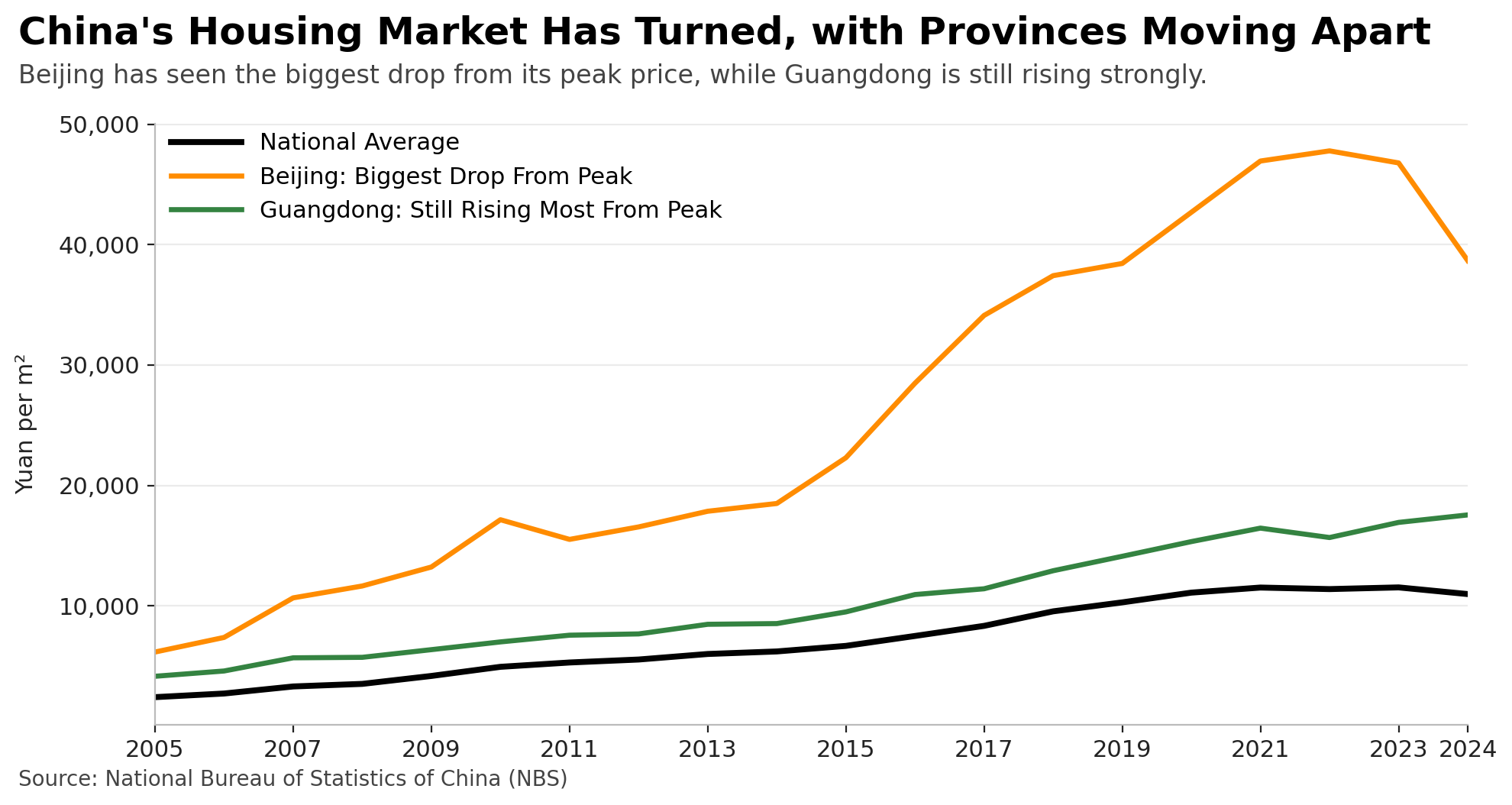
Official data from National Bureau of Statistics of China show that average prices for newly sold residential housing rose steadily over the past two decades, climbing from below 3,000 yuan per square meter in 2005 to around 10,800 yuan in 2021. Then the prices started leveling off and entering a period of decline.
Beijing has been among the most volatile markets. In 2005, average prices for newly sold homes in the capital stood at about 6,200 yuan per square meter. Seventeen years later, that figure had surged nearly sevenfold to around 47,800 yuan. By 2024, prices had retreated to approx. 38,700 yuan, a decline of about 20% from the peak. Some provinces, however, have seen prices stabilize or even rise again after brief downturns. Guangdong, for example, recorded an average price of 17,550 yuan per square meter in 2024, up 3.67% from the previous year.
The housing price myth giving way to the crisis narratives does not mean that homes have become affordable.
Under a simplified assumption:
- purchasing a 100-square-meter home
- supported by two income earners
- with 40% of household income allocated to housing (Households are considered cost-burdened when they spend more than 30% of their income on housing costs, according to the U.S. Department of Housing and Urban Development)
The latest data show that residents in at least five provinces or cities would still need more than 40 years to afford a home. Shanghai and Beijing top the list, requiring an estimated 66.8 and 56.6 years respectively. Even in Hunan, the most affordable province under this framework, the required time exceeds 20 years.
Hover or click provinces to see affordability years, latest price, and latest disposable income. Source: National Bureau of Statistics of China (NBS).
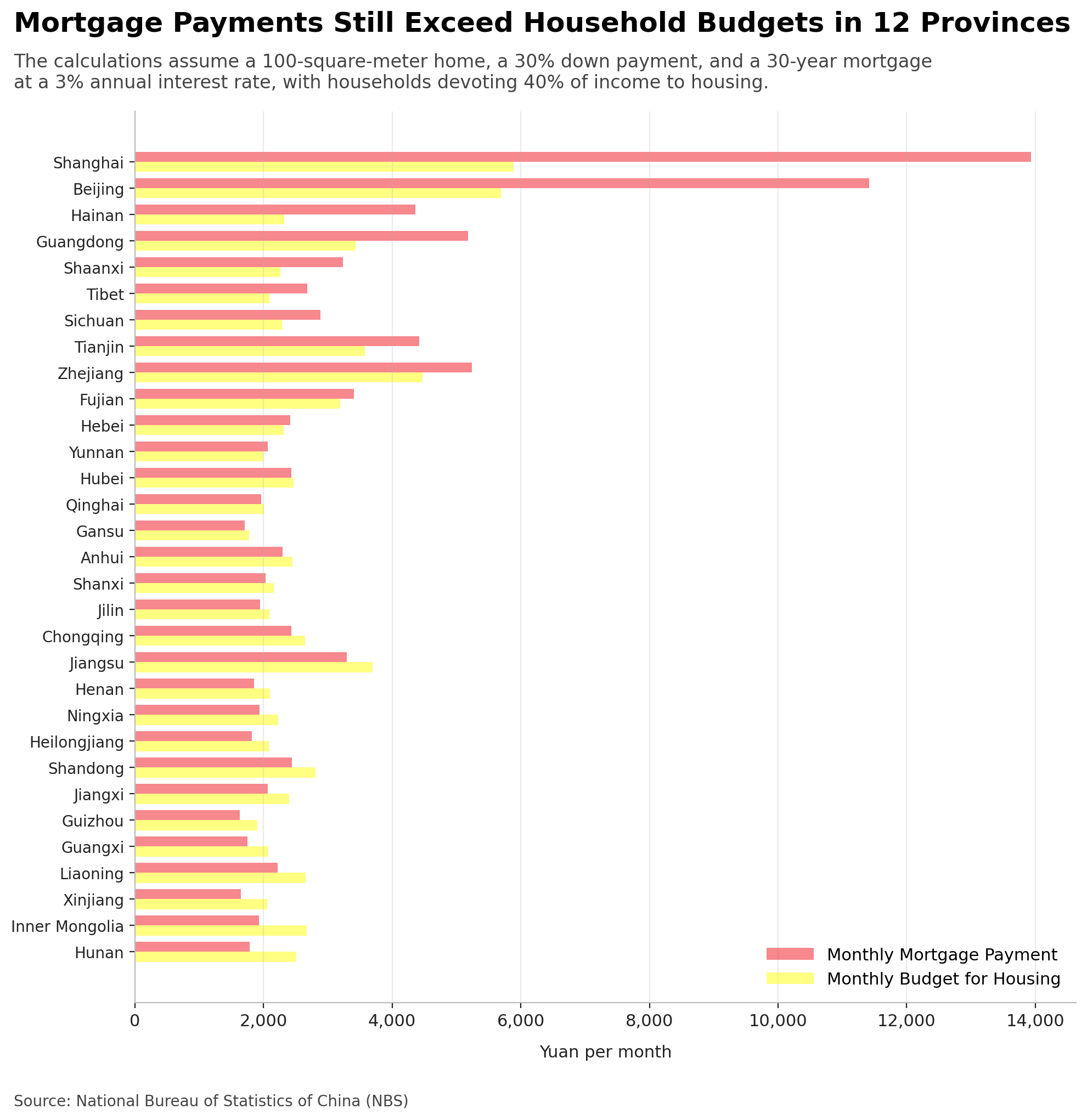
In reality, most home purchases rely on mortgage financing. Applying more detailed assumptions:
- a 30% down payment (the minimum currently allowed by major state banks, such as Bank of China )
- a 30-year loan term (the maxmum currently allowed by major state banks, see above)
- a 3% mortgage rate (the minimum recently announced by China's central bank )
The data reveals a similar pattern. Across 12 provinces, the estimated monthly mortgage payment still exceeds what households can reasonably afford. Shanghai ranks highest, with an average monthly payment of about 14,000 yuan, compared with an average household housing budget of less than 6,000 yuan, marking a gap of approx. 8,000 yuan, or 2.4 times the budget. Hunan remains the most affordable region, where the average monthly payment is about 1,800 yuan against a household budget of approx. 2,500 yuan.
The calculation does not take into account issues such as how to make the down payment. The difference also underscores the deep and persistent regional inequalities across China.
In some way, China now faces a dilemma shaped by its long dependence on property sector. On one hand, the government is determined to stabilize the housing market and prevent further declines in property values, which could rapidly erode household wealth, fuel social discontent, and even trigger national problems in the financial system. On the other hand, the persistent unaffordability of homes could continue to weigh heavily on the public and hamper efforts to boost domestic consumption.
The popularity of the term “tang ping (lie flat)” in recent years reflects this strain, a growing number of young people opting out of working hard for success paths because the promise of a better future feels increasingly out of reach.
Following a key economic policy meeting on December 11, the authority reiterated its commitment to stabilizing the property market, while emphasizing the importance of clearing large volumes of unsold housing.